
The Devil Has a PhD
What Lucifer Understands About Human Behaviour and Why the New Testament Opposes It

Most of what I write is meant to meet you where you are. This is different. Once a month, I go deep into the text, past the surface, and out the other side with something that might change how you see everything. Take your time with it. And if it does something to you, send it to someone. That’s how the good news travels.
I’m going to start with two quotes that I think are central to this week’s article,
“If you know the enemy and know yourself, you need not fear the result of a hundred battles.” — Sun Tzu, The Art of War
“...lest Satan should take advantage of us; for we are not ignorant of his devices.” — 2 Corinthians 2:11
Both these quotes are two thousand years apart, but they hold the same warning.
Most spiritual warfare teaching focuses on what the devil does. This article is about how he thinks.
That is a different discipline entirely — and a more demanding one. Recognising an attack is one skill. Understanding the architecture behind it is another. Critical spiritual intelligence is the capacity to read not just the surface event but the system producing it. It is, in the church, one of the most underdeveloped faculties we have.
There is a popular image of the devil — horns, fire, brute malevolence. It is wrong. Or rather, it is incomplete in ways that leave us poorly equipped.

The more accurate portrait is of a scientist. A profiler. An analyst with trillions of data points and eons of patience, sitting behind a one-way mirror, watching you. Not because he is all-knowing — he isn’t. But because he has studied.
I. The Nature of His Authority
Luke 4:6 is one of the most revealing verses in the New Testament. At the height of a mountain, the devil gestures at the kingdoms of the world and tells Jesus: “All this authority I will give You, and their glory; for this has been delivered to me.”
Examine that claim carefully, and the crack appears immediately.
The authority of Satan is not inherent. It is conditional — derived, secondhand, contingent, entirely on human sin. When mankind turned from God, they handed Lucifer a lease. Not ownership. A lease. And leases depend on the terms of holding.
Real authority is original. It belongs to its holder by nature, not by default. What the devil possesses is closer to a legal claim over property that was never his, enforceable only because the rightful owner defaulted. The moment that default is reversed, the claim dissolves.
This is precisely what the new birth accomplishes. To be born again is not sentiment. It is a change of legal standing. Sin is broken, and with it the authority sin enabled. Which raises the operative question: once that claim is nullified, what does the devil do?
He does what any rational actor does when the law moves against him.
He creates the conditions to try and make you default again.
II. The Predictive Analysis System
Lucifer is not omniscient. He cannot read your mind. He does not know the future. What he has instead is something that, at scale, produces nearly the same result: a comprehensive behavioural model built across the full span of human history.
Every generation. Every culture. Every recorded instance of a person cracking under pressure, drifting under comfort, or walking away from God under accumulated grief. All of it has been observed, catalogued, and run through a system whose logic is straightforward:
Introduce variable A → human produces response X. Introduce variable B → human produces response Y.
Repeat across enough people and enough centuries, and you no longer need certainty. You achieve probability so precise that it is nearly indistinguishable from foresight.
This is not supernatural power. It is pattern recognition at a scale no human institution has ever matched.
The output the system is always trying to produce is one thing: suspicion.
Oswald Chambers identified the root with precision: “The root of all sin is the suspicion that God is not good.” The devil is not primarily after your behaviour. He is after your perception of God’s character. Behaviour is downstream of that. Once the perception shifts, the behaviour follows without him having to engineer it separately.
This is why the target is never simply what you do — it is what you believe about God in the moment you are under pressure. The moment you suspect him — distrust his character, question his presence, conclude you have been abandoned — you have not merely had a bad thought. You have opened the door that the algorithm was built to walk through. You are back inside the model. And inside the model, the variables are already loaded.
The attacks are not random. They are calibrated — assembled from everything the system knows about what produces suspicion in people structured exactly the way you are. Your culture. Your background. Your wounds. Your prejudices, both the ones you are aware of and the ones you have never examined. The system does not need you to know your vulnerabilities. It has already mapped them.

And the goal is not destruction. Destruction is too obvious — it would wake you up. The goal is something far more insidious: a self-sabotaging loop subtle enough to maintain, one that keeps God at a functional distance while leaving you with just enough religion to pacify your conscience. You still attend. You still believe, in some general sense. You still identify as a Christian. But the intimacy is gone, the authority is dormant, and the model is running undisturbed. That is the preferred outcome — not an atheist, but a Christian who has been quietly neutralised.
III. Why the New Testament Breaks the Model
Before we examine what the New Testament does to the devil’s system, we need to correct a foundational misreading of what the New Testament or even what the Bible is.
We have treated it primarily as a spiritual book — devotional, moral, concerned with the interior life. It is those things. But reducing it to those things is precisely what makes us unprepared. The gospel is not a response to Satan. Satan is a response to the gospel. This distinction is not semantic. It changes everything about how you read the text and how you position yourself within it.
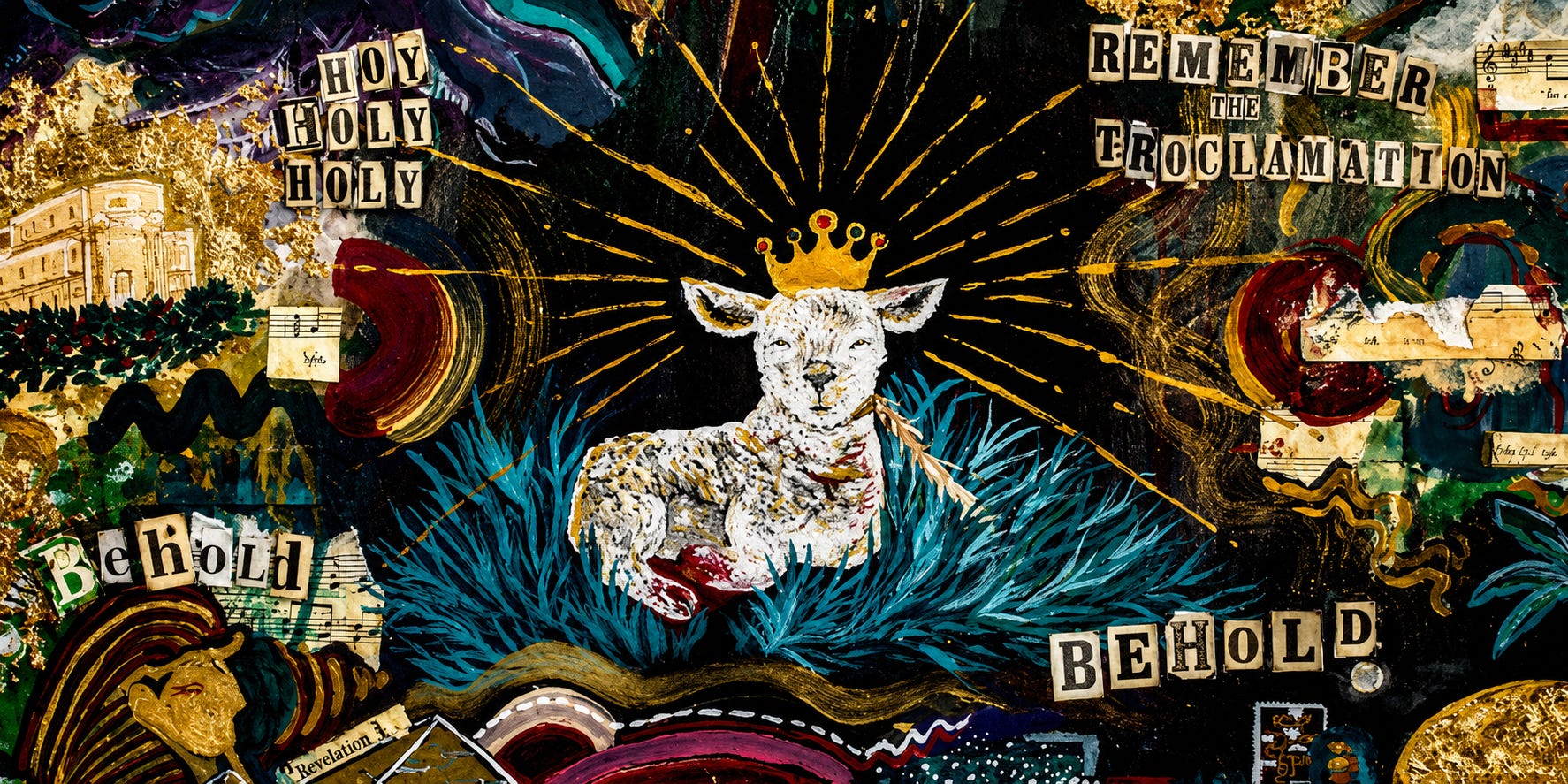
Revelation 13:8 speaks of “the Lamb slain from the foundation of the world.” The cross was not a reaction to what the devil did in the garden. The plan preceded the problem. God’s countermove was already in place before the attack was ever launched, which means the New Testament is not counter-intelligence. It is pre-counter-intelligence. The algorithm the devil has spent millennia refining is itself a response to a design he has been trying to dismantle since before human history began.
The strategy described in the previous section — the calibrated suspicion, the behavioural modelling, the self-sabotaging loop — is not purely spiritual in nature. It is logical. It follows a rational structure: identify the vulnerability, apply the correct variable, and produce the predicted output. Which means the answer to it is equally logical. The gospel does not bypass reason to reach the spirit. It operates through reason, through truth, through a coherent account of reality that — when internalised — makes the devil’s fiction structurally unsustainable.
The problem is not that the church has ignored Scripture. It is that we have read it primarily for comfort and formation, and only rarely as intelligence — as a text that tells you exactly how the enemy operates and precisely what defeats him. Feelings are downstream of what a person believes to be true. The gospel targets belief — specifically, belief about God’s character, which is precisely what the system targets. They are fighting over the same ground. The gospel simply got there first.
This is where the Holy Spirit becomes indispensable — not as a feeling but as a faculty. His role is not simply to comfort you but to make you literate in the patterns. As you read Scripture in partnership with the Spirit, you begin to recognise the moves. You see the same variable being introduced that was introduced in Exodus, in Job, in the Psalms. You see how God responded. You see the outcome. The text is not just doctrine — it is a documented record of every place God has already won. And the Spirit’s job is to make that record available to you in real time, so that when the pattern appears in your life, you can identify it for what it is.
1 Corinthians 2:8 contains a statement that rewards your careful attention:
“For had they known it, they would not have crucified the Lord of glory.”
The powers behind the crucifixion — including spiritual powers — did not know what they were triggering. They ran their calculation. They determined that removing Jesus would neutralise the threat. The model said so. They were catastrophically wrong, because the model had never processed an input like this. A death that was simultaneously a victory. A defeat that was the mechanism of rescue. There was no historical precedent to learn from, no prior data to consult.
You cannot model what you have never encountered.
This is the intelligence behind Jesus’ most counterintuitive instructions. Turn the other cheek — not because suffering is good, but because the response of absorbing injury and returning grace sits entirely outside the dataset. Retaliation is modelled. Bitterness is modelled. Collapse is modelled. A person who does none of those things generates an output that the system has no category for.
Why does Jesus call you to become like him? Because the devil cannot predict Christ.
The Fruit of the Spirit — love, joy, peace, patience, kindness, goodness, faithfulness, gentleness, self-control — is not only a description of character. It is a behavioural profile that the enemy’s system was not built to handle. Producing those responses under pressure is not just obedience. It is a disruption. Every time the model expects one output and receives another, it fails.
IV. The Anatomy of a Temptation
Luke 4:13 deserves more attention than it typically receives:
“When the devil had finished every temptation, he departed from Him for a time.”
What actually happened in that exchange? Not a contest of power. Jesus did not overpower the devil through force. There was no raw confrontation of strength against strength.
It was a contest of records.
The devil introduced propositions — each one a piece of fiction structured to produce a specific response:
Hunger introduced → identity becomes uncertain → prove yourself through bread. Protection claimed → trust becomes a test → jump and see if God catches you. Kingdoms offered → allegiance becomes negotiable → reconsider your terms.

Each proposition was an attempt to open a door the model already knew how to walk through. But notice what Jesus did not do. He did not argue with the devil’s framing. He did not engage the emotional weight of the offer. He reached into Scripture and produced a record — evidence of a place where God had already established the truth the devil was now trying to obscure.
He was not simply quoting verses. He was pointing at a track record.
Every scripture Jesus cited said, in effect: this area you are offering me, God has already won here. This is not new ground. This is settled territory. The devil was not being outargued. He was being shown his own losing history — case by case, instance by instance, pulled from a text he could not contradict because he was there when it happened.
That is why he left. Not simply because Jesus was the Son of God, but because Jesus, in partnership with the knowledge of Scripture, was reminding him: you have no new moves here. Every version of this has already been answered.
This is the operational template. Without the Word, you have no records to draw from — only your feelings, your circumstances, and your interpretations, all of which the system already knows how to use. But with it, and with the Spirit who makes the connection between the text and the moment, you can do what Jesus did: identify the pattern, locate the prior victory, and point to it.
The fiction loses its grip not because you overpower it, but because you have evidence it has already been defeated.
V. The Sequence That Cannot Be Reversed
James 4:7 is the clearest operational instruction in Scripture on this subject:
“Submit to God. Resist the devil, and he will flee from you.”
The order is not decorative. It is load-bearing. And it maps directly onto everything described above.
The model runs like this:
Suspicion introduced → trust in God erodes → behaviour shifts → the algorithm advances.
The counter-sequence is:
Submit to the Word → identity is anchored → fiction (the lies of the devil) has nothing to attach to → resistance works.
Submission to God is not passivity. It is submission to what God has said — about who you are, what has been secured for you, and what is actually true about your situation regardless of how it feels. That settled knowledge is what makes resistance possible. Without it, resistance is just willpower, and willpower is one of the variables the system has already modelled.
High pressure applied → willpower depleted → predictable response produced.
The Word changes the variable. It introduces something the model cannot reliably process, because a person anchored in truth does not respond the way the profile predicts.
This is also why Luke 4:35 matters — Jesus does not argue with the tormenting voice. He rebukes it. The practical instruction that follows is simple:
Voice or thought enters → rebuke it by name → replace it with what is true.
Not a ritual. A data substitution. You are interrupting the sequence the model depends on and inserting a fact where the fiction was trying to take hold.
The devil’s system is ancient, patient, and vast. But it is still a system. It was built on observation of fallen human behaviour and you are no longer required to behave that way.
The plan to counter it was written before the system existed.
You were included in that plan before you were born.
That is not encouragement. That is intelligence.
Wow! Eyes wide open, thank you so much for this 🙏🏾